

Health anxiety has a way of showing up uninvited. One moment you’re fine, and the next you’re spiraling over a symptom you googled at 1 a.m. Your heart races. Your mind catastrophizes. And suddenly, you’re convinced something is terribly wrong. Even when deep down, you know you’re probably okay.
If that sounds familiar, you’re not alone. I’ve been there myself and struggled with health anxiety and derealization for three miserable years. Yes, three. But over time I found tools that actually work that I’m going to share with you guys today. Also remember— health anxiety doesn’t mean you’re weak or faithless. It means you’re human, and here’s the truth: God’s Word offers real, practical comfort for the fears that keep us up at night. Today, we’re diving into Bible verses to overcome health anxiety and worry about health issues. Not as a quick fix, but rather as a foundation to stand on when worry tries to take over.
P.S. To receive these blogs straight to your email along with tips for anxiety, come join our cozy Substack community. It’s completely free and takes just a moment to subscribe here.
Why Health Anxiety Feels So Real
Before we get into Scripture, let’s acknowledge something important: health anxiety isn’t just “being dramatic.” It’s a legitimate struggle that affects millions of people. Whether it stems from past trauma, a medical scare, or simply the constant bombardment of worst-case scenarios online, health anxiety can absolutely be all-consuming. So don’t listen to anyone that says otherwise. Often times others assume everyone’s anxiety is the typical— minor worries before socializing, or some annoying but manageable butterflies in your gut, etc; but anyone who’s dealing or has dealt with with health anxiety or hypochondria knows how debilitating severe anxiety can get. People often have good intentions so don’t take it to heart, they may just not fully understand.
Your body is designed to protect you. When you perceive a threat (real or imagined) your nervous system kicks into overdrive. But when that threat is your own health, it creates a vicious cycle: anxiety creates physical symptoms, which fuel more anxiety, which creates more symptoms. It’s exhausting.
The good news? God understands our bodies and minds better than we ever could. He doesn’t shame us for our anxiety. Instead, He offers us truth to combat the lies fear whispers.
The Power of a Cheerful Heart: Proverbs 17:22
Let’s start with a verse that might surprise you in a conversation about health anxiety:
“A cheerful heart is good medicine, but a crushed spirit dries up the bones.” — Proverbs 17:22 (NIV)
At first glance, this might sound like the Bible is telling you to “just be happy.” But that’s not what’s happening here. Solomon, the wisest man who ever lived, is making an observation about the connection between our inner life and our physical well-being.
A cheerful heart, a spirit that finds joy, peace, and contentment in God, actually affects your body in tangible ways. Modern science backs this up. Studies show that chronic stress and anxiety weaken the immune system, disrupt sleep, and even contribute to inflammation. Meanwhile, positive emotions, laughter, and peace have been shown to improve health outcomes.
But here’s the deeper truth: when your spirit is “crushed” by constant worry, it drains you. Not just emotionally, but physically. You feel it in your bones. Your energy disappears. Your body tenses up. You can’t sleep. You can’t think straight.
So what does a “cheerful heart” look like when you’re battling health anxiety? It’s not about forcing yourself to smile or pretending everything’s fine. It’s about choosing, moment by moment, to redirect your thoughts toward what’s true, what’s good, and what’s within your control.
Practical Application: Shift Your Focus
When health anxiety strikes, try this:
- Pause. Take three deep breaths. Acknowledge the fear without judgment.
- Replace the thought. Instead of “What if something’s seriously wrong?” try “Right now, in this moment, I am okay.”
- Find one thing to be grateful for. Even something small. A warm cup of tea. Sunlight through the window. A text from a friend.
This isn’t toxic positivity. It’s retraining your brain to recognize that joy and peace are still accessible, even in the middle of fear.
Kind Words as Healing: Proverbs 16:24
Here’s another gem from Proverbs that speaks directly to the mind-body connection:
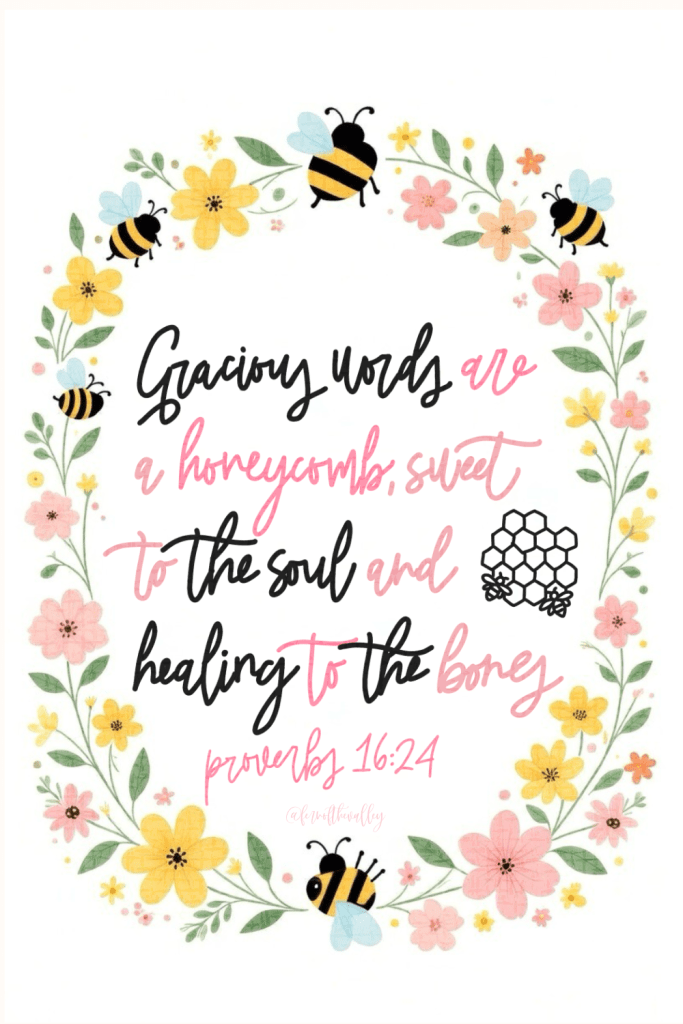
“Gracious words are a honeycomb, sweet to the soul and healing to the bones.” — Proverbs 16:24 (NIV)
Notice the pattern? Solomon keeps talking about bones. The very foundation of our physical structure. He’s reminding us that what we consume mentally and emotionally has a profound effect on our physical health.
“Gracious words” aren’t just words other people speak to us. They’re also the words we speak to ourselves.
If you struggle with health anxiety, chances are you’re not very kind to yourself. You might tell yourself things like:
- “I’m overreacting again.”
- “Why can’t I just be normal?”
- “Something is definitely wrong with me.”
- “I’m being ridiculous.”
Those words aren’t gracious. They’re harsh. And they’re not healing. They’re crushing.
What if, instead, you started speaking to yourself the way God speaks to you? With patience. With compassion. With truth.
Rewriting the Narrative
Next time you catch yourself spiraling, try reframing your inner dialogue:
- Instead of: “I’m overreacting.”
Try: “I’m scared right now, and that’s okay. My feelings are valid.” - Instead of: “Something is definitely wrong.”
Try: “I’ve been anxious before, and I’ve always been okay. This feeling will pass.” - Instead of: “I’m being ridiculous.”
Try: “I’m doing the best I can. It’s okay to need support.”
Words matter. The way you talk to yourself matters. And when you start replacing harsh, fearful self-talk with gracious, truthful words, you create space for healing. Not just emotionally, but physically too.
If you’re looking for more encouragement on trusting God through the hardest seasons, check out this post on The Lord Is My Shepherd: Comfort in Psalm 23:4 During Dark Valleys.
Understanding the Root of Health Anxiety
Here’s something most people don’t talk about: health anxiety is often less about health and more about control.
When we fixate on our bodies, constantly checking for symptoms or googling every ache and pain, we’re trying to control the uncontrollable. We’re trying to predict the future. We’re trying to protect ourselves from suffering.
But Scripture tells us that control is an illusion. We can’t add a single hour to our lives by worrying (Matthew 6:27). We can’t prevent illness or injury by obsessing over every sensation.
What we can do is surrender. And I know that word feels terrifying when you’re already anxious. But surrender doesn’t mean giving up. It means releasing the false belief that constant vigilance will keep you safe.
God is the One who holds your life in His hands. Not WebMD. Not your anxious thoughts. Not even your best efforts at self-protection.
What Surrender Looks Like in Real Life
Surrendering your health anxiety to God doesn’t happen all at once. It’s a daily (or sometimes hourly) decision. Here’s what it can look like practically:
- Limit Dr. Google. Set a boundary for yourself. Maybe you allow yourself one search per concern, and then you stop.
- Get grounded in your body. Try the 5-4-3-2-1 technique: name 5 things you see, 4 things you can touch, 3 things you hear, 2 things you smell, 1 thing you taste. This pulls you out of your anxious mind and back into the present moment.
- Pray before you panic. When a symptom shows up, make it a habit to pray first. Even if it’s just: “God, I’m scared. Help me trust You.”
For practical tools and resources that have helped me manage anxiety, you can check out my curated Amazon favorites here— things like journals, devotionals, and calming essentials that make a real difference.

When to Seek Help (And Why That’s Okay)
Let’s be really clear about something: trusting God doesn’t mean ignoring your body or refusing medical care.
If you’re experiencing persistent symptoms, see a doctor. If your anxiety is debilitating, talk to a therapist. God often works through doctors, counselors, and medication. Seeking help isn’t a lack of faith, it’s wisdom.
There’s a difference between responsible self-care and obsessive checking. One comes from a place of stewardship; the other comes from fear. Ask God to help you discern the difference.
And if you’ve been to multiple doctors and everything checks out, but the anxiety persists? That’s your cue to address the anxiety itself, not the body part you’re fixated on.
Therapy, especially approaches like Cognitive Behavioral Therapy (CBT) or Acceptance and Commitment Therapy (ACT), can be incredibly effective for health anxiety. So can working with a Christian counselor who can integrate faith into the healing process.
Building a Daily Practice of Peace
If you want to overcome health anxiety, you need more than just Bible verses. You need a daily rhythm that grounds you in truth.
Here’s what that might look like:
Morning Routine
Start your day with Scripture before you check your phone. Even just one verse. Let truth be the first thing your mind consumes.
Try writing Proverbs 17:22 or Proverbs 16:24 on a notecard and reading it out loud. Let those words sink in before the day’s worries have a chance to take root.
Throughout the Day
When anxiety spikes, pause and pray. It doesn’t have to be long or eloquent. Just honest.
Practice belly breathing: inhale for 4 counts, hold for 4, exhale for 6. This activates your parasympathetic nervous system and tells your body it’s safe.
Evening Routine
Journal about one thing that went well today. One moment of peace. One evidence of God’s faithfulness.
This trains your brain to look for the good instead of constantly scanning for danger.
You’re Not Alone in This
One of the hardest parts of health anxiety is the isolation. You feel like you’re the only one spiraling. Like everyone else has it together. Like you should be stronger, more faithful, more resilient.
But the truth is, so many people are walking this same road. And God sees you. He’s not disappointed in you. He’s not frustrated by your fear.
He’s the God who knit you together in your mother’s womb (Psalm 139:13). He knows every cell, every neuron, every breath. And He’s holding you, even now.
You don’t have to have it all figured out. You don’t have to be “healed” overnight. You just have to take the next small step. Read the verse. Speak the kind word. Take the breath. Trust Him for today.
And tomorrow? You’ll do it all over again.
About The Author
Selah is a Christian blogger and hand lettering artist—passionate about offering Christian advice about anxiety and healing. Through devotionals, practical faith tips, and cozy reflections, she helps women trade worry for peace by resting in God’s promises and presence.
✦ Make sure to follow my socials! → https://linktr.ee/selahshalom
✦ Shop devotional art and prints here → https://fernofthevalley.com/shop/
Sources
National Institute of Mental Health. (n.d.). Anxiety Disorders.


 Fern Of The Valley
Leave a comment